04 343 1113
 info@neuropedia.ae


The diagnostic landscape for neurodevelopmental conditions has evolved significantly over the last decade, particularly regarding how clinicians categorise the levels of autism. Since the publication of the Diagnostic and Statistical Manual of Mental Disorders, Fifth Edition (DSM-5), previously distinct diagnoses like Asperger’s Syndrome and Pervasive Developmental Disorder Not Otherwise Specified (PDD-NOS) have been brought together under one umbrella: Autism Spectrum Disorder (ASD).
This spectrum approach recognises something important that while all individuals with ASD share certain core challenges, the intensity of those challenges and the degree of support needed can look very different from one person to the next. For families and educators, understanding these different levels of autism is not just a clinical exercise. It is the foundation for getting each individual the right kind of help at the right time.
Understanding the DSM-5 framework for Autism Levels
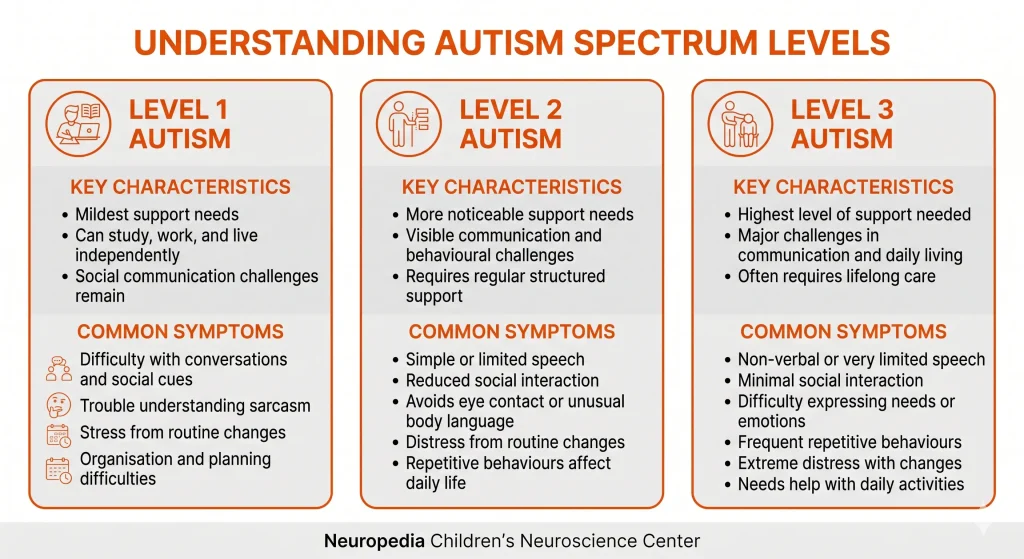
One of the first questions families ask after a diagnosis is: How many levels of autism are there? The DSM-5 identifies three. It is important to note from the outset that these levels are not a measure of a person’s intelligence or character. They are based on one thing only, how much support a person needs to navigate daily life, social situations, and repetitive behaviours.
Think of it this way: Level 1 means a person needs some support. Level 2 means they need substantial support. Level 3 means they need very substantial support. These descriptors are not fixed forever either. With the right therapies and the right environment, a person’s support needs can shift as they grow and develop.
What is level 1 Autism?
Level 1 is often described as the mildest part of the spectrum, though “mild” does not mean easy. Individuals here can often function with a good degree of independence in the right settings, and they may not have significant intellectual or language delays. But they do face real challenges, ones that affect their social lives, their working lives, and their sense of ease in the world around them.
Level 1 Autism symptoms
The autism level 1 symptoms tend to centre around social communication and cognitive flexibility. A person might find it genuinely difficult to start a conversation or to read the subtle social cues that others pick up without thinking. Sarcasm and non-literal language can be particularly confusing. They may struggle to keep a back-and-forth conversation flowing in the way others expect.
When it comes to repetitive or restrictive behaviours, switching between tasks can be surprisingly stressful. When routines are disrupted, it can feel destabilising rather than merely inconvenient. Organisation and planning, what clinicians call executive functioning are also common areas of difficulty.
So what is level 1 autism in everyday terms? It often looks like someone who attends a mainstream school, holds down a job, and appears to manage well on the surface, but who quietly struggles with the unwritten rules of social interaction that most people never have to think about.
What is Level 2 Autism?
At Level 2, the gap between what a person can do and what is expected of them becomes more visible. The challenges are more pronounced, and the support required is considerably greater.
Level 2 Autism symptoms
The level 2 autism symptoms show up more noticeably in both verbal and non-verbal communication. A person might speak in short, simple sentences or have a limited vocabulary. Their social interactions may be largely restricted to their specific interests, and behaviours such as avoiding eye contact or using unusual body language are often more apparent to others.
Parents sometimes ask: Is level 2 autism high-functioning? It is worth knowing that “high-functioning” is no longer a clinical term. Level 2 sits in the mid-range of the spectrum. People at this level often find change particularly hard to manage a disrupted routine can trigger real distress rather than mild frustration.
Their repetitive behaviours are frequent enough that others tend to notice, and they can interfere with the ability to engage in varied activities or maintain focus. Understanding what is level 2 autism means holding two things in mind at once: These individuals have genuine strengths, and they also need consistent, structured support to navigate a world that can feel overwhelming.
What is level 3 Autism?
Level 3 sits at the most intensive end of the spectrum. The challenges here are often evident from a very young age and touch every part of daily life, communication, sensory processing, and the ability to manage change.
Autism level 3 symptoms
The autism level 3 symptoms are often profound. Many individuals at this level are non-verbal, or rely on only a small number of functional words. They may rarely initiate social interaction and may not respond when others try to engage with them. Expressing even basic needs or emotions can be very difficult.
Repetitive behaviours at this level, rocking, hand-flapping, spinning objects, are constant and significantly impact daily functioning. Even small changes in the environment can cause extreme distress.
When families ask ‘what is level 3 autism?’ The honest answer is that it involves a lifelong need for a high level of care, specialised education, and often support with everyday tasks like dressing or eating. It asks a great deal of families, and understanding that early is important for planning the right kind of long-term support.
Comparison of support needs across the spectrum
To give a clearer sense of how the different levels of autism compare, here is a side-by-side overview:
| Feature | Autism level 1: Requiring support | Autism level 2: Requiring substantial support | Autism level 3: Requiring very substantial support |
| Social communication | Difficulty initiating social interactions; may appear “awkward” | Marked deficits in verbal and non-verbal skills; limited initiation | Severe deficits; very limited functional speech or non-verbal communication |
| Social engagement | May struggle to make friends but wants social contact | Interactions are limited to narrow interests or simple needs | Very limited response to social overtures from others |
| Repetitive behaviours | Difficulty switching activities; issues with organisation | Frequent repetitive behaviours; clear distress during change | Constant repetitive behaviours; extreme difficulty with change |
| Daily independence | Can often live independently with minimal guidance | Needs a structured environment and regular assistance | Requires 24/7 care or intensive daily supervision |
Why does the distinction between levels matter?
Correctly identifying the levels of autism is not a bureaucratic exercise, it is the foundation of an effective treatment plan. At centres like Neuropedia, the level assigned during a diagnostic evaluation helps insurance providers, schools, and therapists determine how much support a person genuinely needs.
A child with autism level 2 might require around 20 hours of Applied Behaviour Analysis (ABA) therapy per week, for example, while a child with autism level 1 might benefit more from social skills groups and executive functioning coaching.
These levels also help families manage expectations in a realistic and compassionate way. Understanding the autism level 3 requirements allows parents to begin planning for long-term support and to seek out specialised resources early, before a crisis, rather than during one.
Perhaps most importantly, the language of “support needs” moves the conversation away from stigmatising labels like “high-functioning” or “low-functioning,” which tend to oversimplify and, in doing so, do a disservice to the individuals they describe.
The role of early intervention in changing levels
One of the most encouraging findings in modern neuroscience is the concept of neuroplasticity, the brain’s capacity to adapt and reorganise. A child diagnosed with autism level 2 symptoms at three years old is not necessarily going to need the same level of support at thirteen.
Intensive early intervention, when it begins promptly and is well-matched to the child’s needs, can genuinely make a difference. Speech therapy, occupational therapy, and behavioural interventions have all been shown to help children build skills that bridge developmental gaps.
Regardless of the level, the goal is always the same: a better quality of life. For a child with level 3 autism, a meaningful milestone might be learning to use a communication device to express hunger. For a teenager with level 1 autism, it might be navigating a job interview successfully. Every step forward matters, and the autism levels serve as a roadmap not a ceiling for that progress.
When to seek a professional evaluation?
If your child is missing developmental milestones, or if you recognise behaviours that align with the levels of autism described here, a formal evaluation is the right first step. Specialists typically use tools such as the Autism Diagnostic Observation Schedule (ADOS-2) and the Autism Diagnostic Interview-Revised (ADI-R) to gather the clinical data needed to understand where an individual sits on the spectrum.
At Neuropedia, we understand that no two children are alike. Whether a family is trying to make sense of what is level 1 autism or navigating the intensive demands of autism level 3, our multidisciplinary team provides evidence-based care that is tailored to the specific needs of each person. The autism levels are a starting point, what matters most is what we do with that understanding.
Take the first step toward specialised care.
Early diagnosis and a clear understanding of your child’s specific support needs are vital for their development. At Neuropedia, our team of experts is here to guide you through every stage of the journey, from comprehensive evaluations to personalised therapy plans. Book a consultation with our neurodevelopmental specialists today and let us help your child thrive.


.png)